Evolutionary algorithms for GRN
Functions to apply evolutionary algorithms to models of GRN are included here.
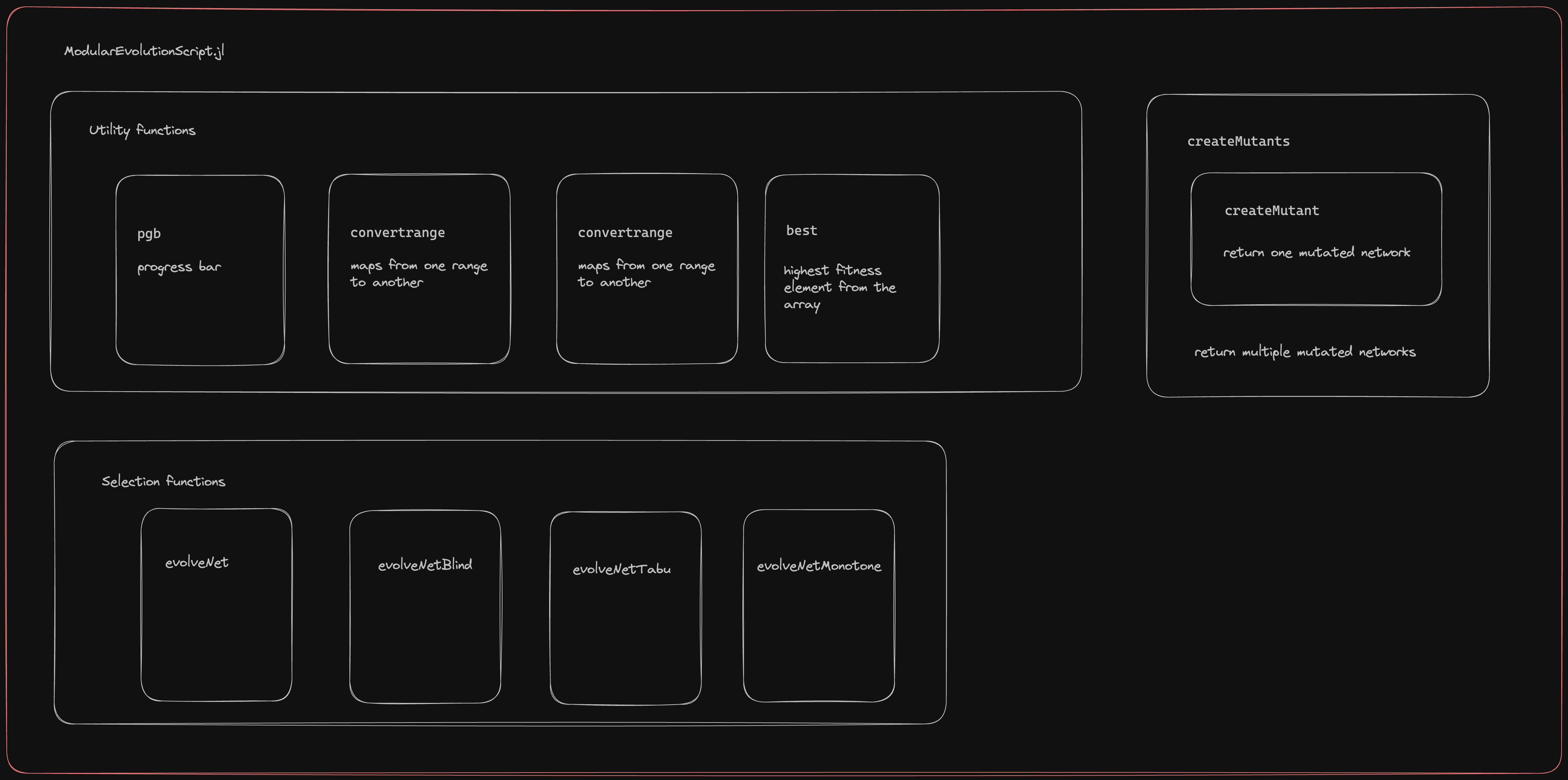
Steps
Include the script in Julia environment
include("ModularEvolutionScript.jl")Define a Fitness Function that takes in an interaction matrix, and returns a score.
fitnessfunction(A) = sum(A) # for exampleDefine an initial network as an interaction matrix.
J = rand(-1:1, 10, 10) # 10 X 10 random matrix with elements in {-1, 0, 1}Call the evolutionary algorithm function with the above two parameters.
X, Xs = evolveNet(J, fitnessfunction)X is a vector of the best networks at each iteration, and Xs a vector of their fitness.
Available evolution functions
evolveNet: Keeps track of all the networks previously generated. New networks generated are tested only if they are not previously generated. (The algorithm slows down with the number of iterations due to this check).
evolveNetBlind: Generates mutants at each iteration, selects the best one. No memory of what networks have already been seen. (Likely to get stuck in local optima).
evolveNetTabu: Keeps a list of networks seen in the last k generations (default k=10). Generated mutants are considered only if they are not in this list.
evolveNetMonotone: A mutant is selected only if its score is greater than all the networks previously seen. (And thus may return fewer selected networks than the number of iterations).
Additional arguments
The functions implementing the evolutionary algorithms can take in these additional parameters.
function evolveNet(J::AbstractMatrix,
                    fitnessFunction::Function;
                    nmutants::Int=10,
                    nr::Int=0,
niter::Int=100)nmutants: number of mutants generated in each iteration.
nr: number of elements mutated at each iteration. (If 0 is passed, the mutation rate is 10%. i.e, 10% of the edges are mutated).
niter: number of iterations of mutation-selection.